
The Intent Gate
On staying in the gap — the silence — when nothing confirms that you should.

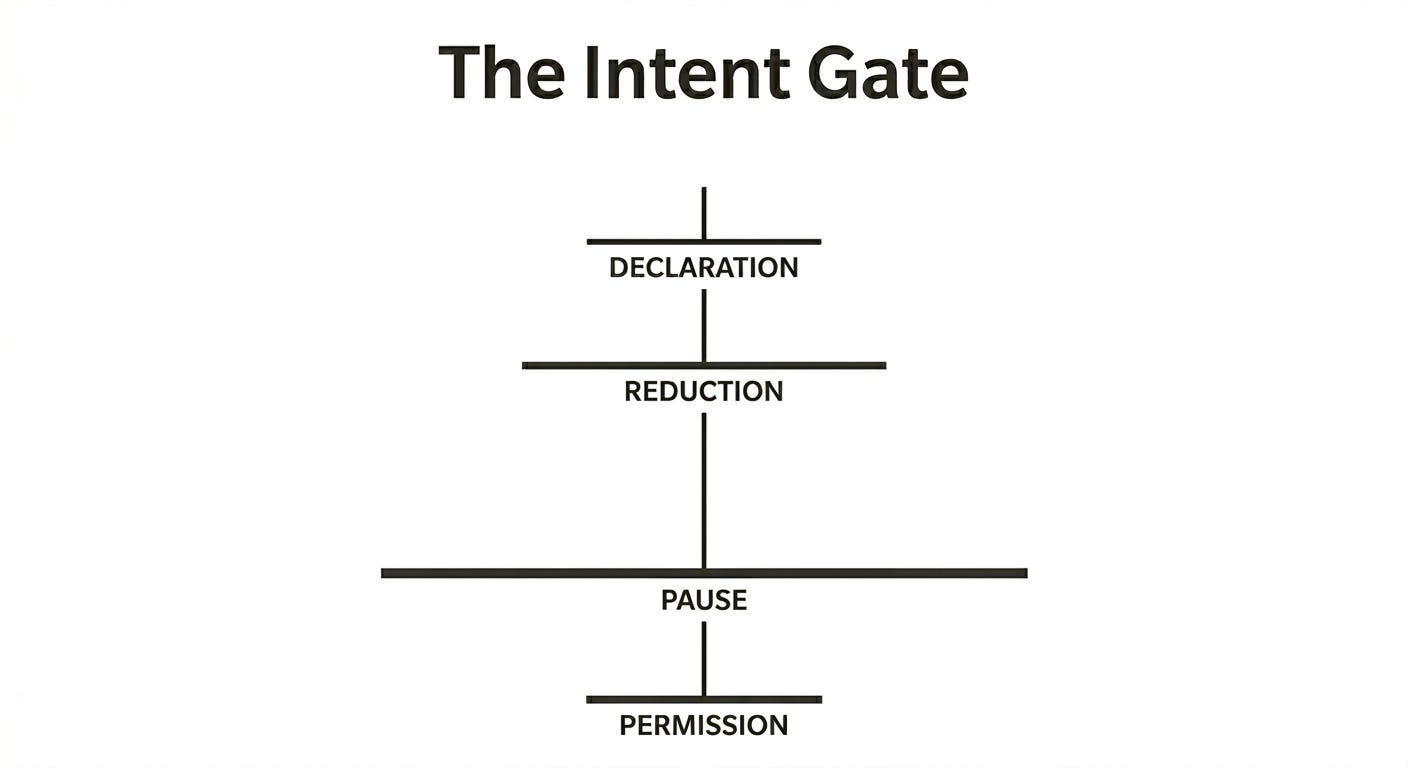
Declaration
Every real change begins the same way.
Not with movement. Not with a plan.
With a declaration made in private, to no one, that something is no longer acceptable.
That the old form has reached its limit.
That whatever comes next — uncertain, unscheduled, unconfirmed — is preferable to what staying would cost.
Most people never name that moment.
They move anyway. They rebuild the work, the role, the life.
And the new version carries everything the old one did.
The noise travels with them. Nothing was named first. Nothing was cleared.
The declaration is not a feeling.
It is a gate.
It either opens or it doesn’t.
Reduction
Before the next move there is always a reduction.
Not addition. Not strategy.
Not the layering of new commitments on top of unresolved ones.
Reduction.
The removal of what the previous form required that this one cannot carry forward.
This is the part most people skip.
It produces nothing visible.
There is no artifact to show for it. No metric. No milestone.
Just the quiet work of clearing what no longer belongs.
Skipping it is the most expensive decision in any transition.
Because everything built on uncleared ground inherits the weight of what wasn’t removed.
The redesign becomes a renovation.
The renovation becomes a replication.
The same constraints running in a newer structure.
Reduction is not loss.
It is preparation.
The form that follows is secondary.
The sequence is not.
Pause
Then comes the pause.
Not a gap in productivity.
Not a failure of momentum.
A structural period.
The only time in the entire lifecycle where the signal is audible without interference.
Where what you actually want — not what you have been conditioned to want, not what the feed reflects back, not what the market currently rewards — can be heard clearly.
Most people treat this period as something to escape.
They fill it.
With applications. With activity.
With the performance of forward motion.
And in filling it they lose the only window in which the next declaration can form cleanly.
The pause is not empty.
It is doing the work that nothing external can do for you.
The bills arrive anyway.
The silence doesn’t negotiate.
The void doesn’t confirm anything in either direction.
That is precisely what makes it structurally necessary.
Confirmation would end it too early.
Some mornings the only evidence you have is the decision itself.
No reply. No signal.
Just a quiet hum of a machine and a choice still standing in a silence that has no timeline.
That is not the absence of progress.
That is what progress looks like from the inside of this period.
Permission
The last step before movement is the one least discussed.
Permission.
Not permission from a title or an institution or a market.
Internal permission.
The updated boundary around what you are now allowed to become.
The old constraint lifted.
The new one installed in its place.
Most people change everything external and find the same limitations still running.
Because the internal permission was never updated.
The old version of what was acceptable, what was safe, what was realistic, what was deserved, stayed installed.
Quietly governing every new decision from underneath.
Permission is the first boundary.
It precedes movement.
It shapes everything that follows.
You cannot build a new architecture on an unrevised permission structure.
The ceiling travels with you until you name it and raise it deliberately.
These four movements are not a framework.
They are a description of what actually happens when a real change is underway.
Declaration. Reduction. Pause. Permission.
They are not linear in feeling.
They overlap. They repeat.
Some days the pause feels like failure.
Some days the reduction feels like loss.
Some days the declaration feels like arrogance dressed as clarity.
It is none of those things.
It is the work.
The invisible work that makes everything downstream possible.
The work that produces no artifact, no signal, no external confirmation and is, for precisely that reason, the part most people abandon before it completes.
If you are in it right now — in the silence, in the gap, in the space between the decision made and the evidence it was right — this is what that is.
Not paralysis. Not failure. Not falling behind.
The Intent Gate.
It either clears or it doesn’t.
And it clears from the inside.